How to Complete the AI Governance Readiness Test in AI Register | Step-by-Step Guide
How to Complete the AI Governance Readiness Test
This guide explains how to complete the AI Governance Readiness Test in AI Register, what each section is really asking, and how to understand the results shown at the end. The test is designed to help firms assess governance maturity in a practical way, not just work through a technical checklist.
The goal is to give your firm a clearer picture of awareness, oversight, risk management, control strength, and future preparedness. The most useful results come from answering honestly based on your firm’s current position today.
Register your firm first
Before taking the Readiness Test, make sure your firm already has an AI Register account. If registration has not Read the registration guide →
Readiness Test
AI governance
Governance maturity
- Step 0: Register your firm first
- Before you begin
- How the test works
- Step 1: Open the Readiness Test
- Step 2: Complete Section 1 — AI Usage Awareness
- Step 3: Complete Section 2 — Governance & Responsibility
- Step 4: Complete Section 3 — Risk & Compliance
- Step 5: Complete Section 4 — AI Controls & Oversight
- Step 6: Complete Section 5 — Strategy & Future Readiness
- Step 7: Complete the assessment and review the results
- Understanding your results
- Section breakdown
- Recommended next steps
- Using the results well
- Look out for common mistakes
Step 0: Register your firm first
The Readiness Test sits inside AI Register, so the first step is making sure your firm has already been registered. If you have not created your account and completed the initial setup yet, start there first.
Use this guide first: How to Register for AI Register
Before You Begin
Before taking the test, log in to your AI Register account, open the left-hand menu, and select Readiness Test. When answering, use your firm’s current position as it really is now, not what you plan to put in place later.
- ✓Register for AI Register first
- ✓Log in to your account
- ✓Open the left-hand menu and select Readiness Test
- ✓Answer based on your firm’s current controls, awareness, and governance maturity
Helpful tip: if a control is informal, inconsistent, or only partly in place, it is usually better to answer cautiously. The value of the test comes from realism, not optimism.
How the Test Works
The assessment is divided into five sections. Each one looks at a different area of AI governance inside your firm, from basic visibility over tool usage through to governance structure, compliance risk, operational controls, and future readiness.
- Section 1: AI Usage Awareness
- Section 2: Governance & Responsibility
- Section 3: Risk & Compliance
- Section 4: AI Controls & Oversight
- Section 5: Strategy & Future Readiness
Step 1: Open the Readiness Test
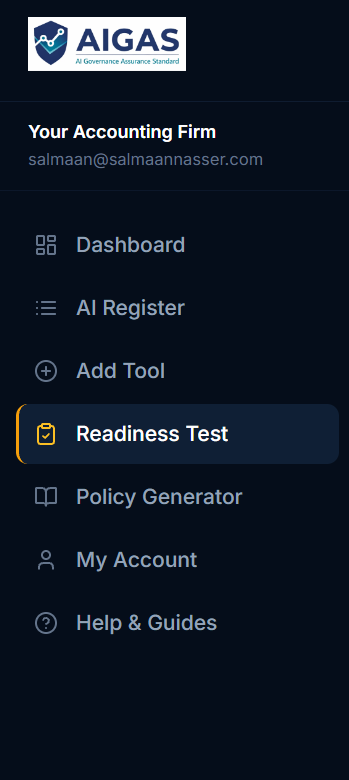
After logging in, use the left-hand navigation and select Readiness Test. This is the entry point into the assessment.
Then do this: work through each section honestly and consistently.
Step 2: Complete Section 1 — AI Usage Awareness
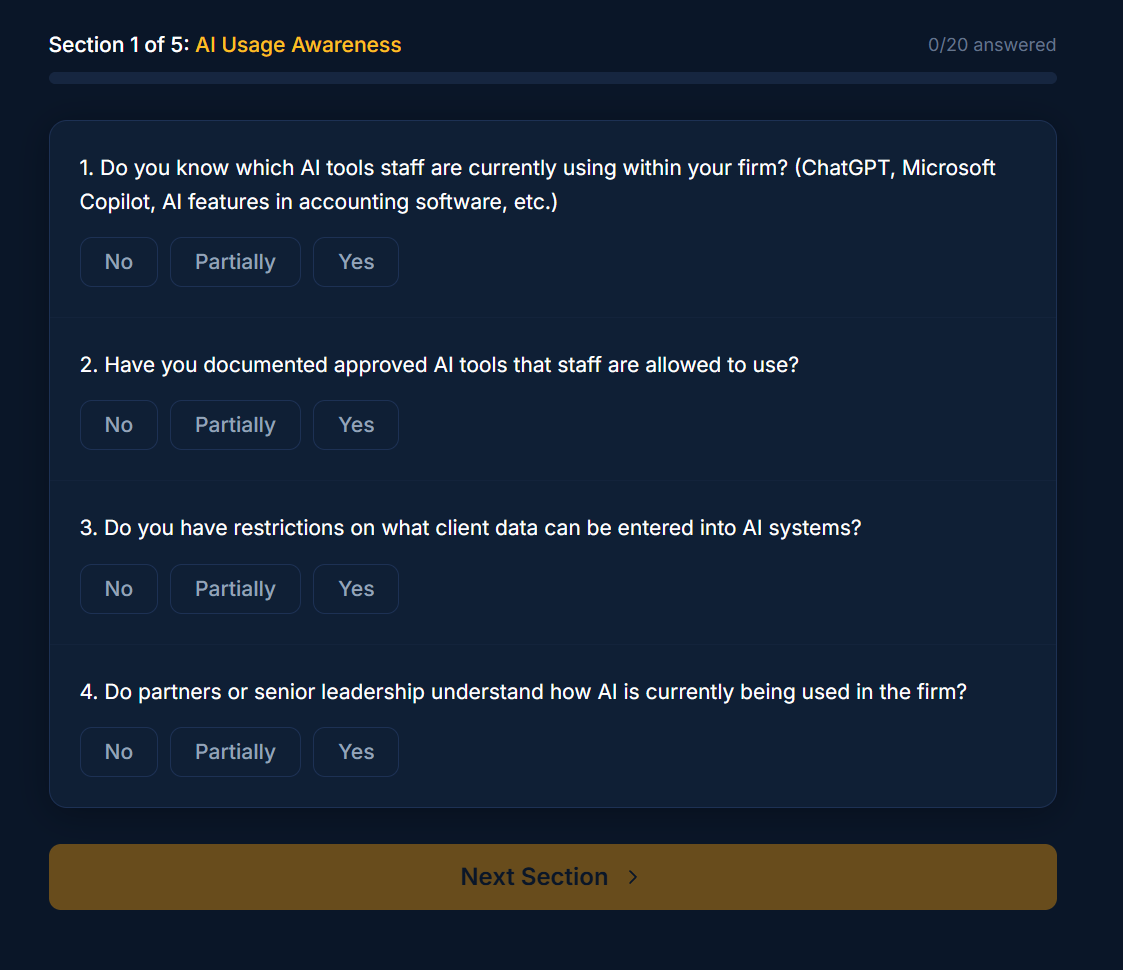
This section is about visibility. It asks whether your firm knows which AI tools are currently being used, whether approved tools have been documented, whether restrictions exist on client data going into AI systems, and whether senior leadership understands how AI is being used.
The key issue here is awareness. If the firm does not know what tools are in use, by whom, or for what purpose, it becomes very difficult to apply sensible controls or manage risk properly.
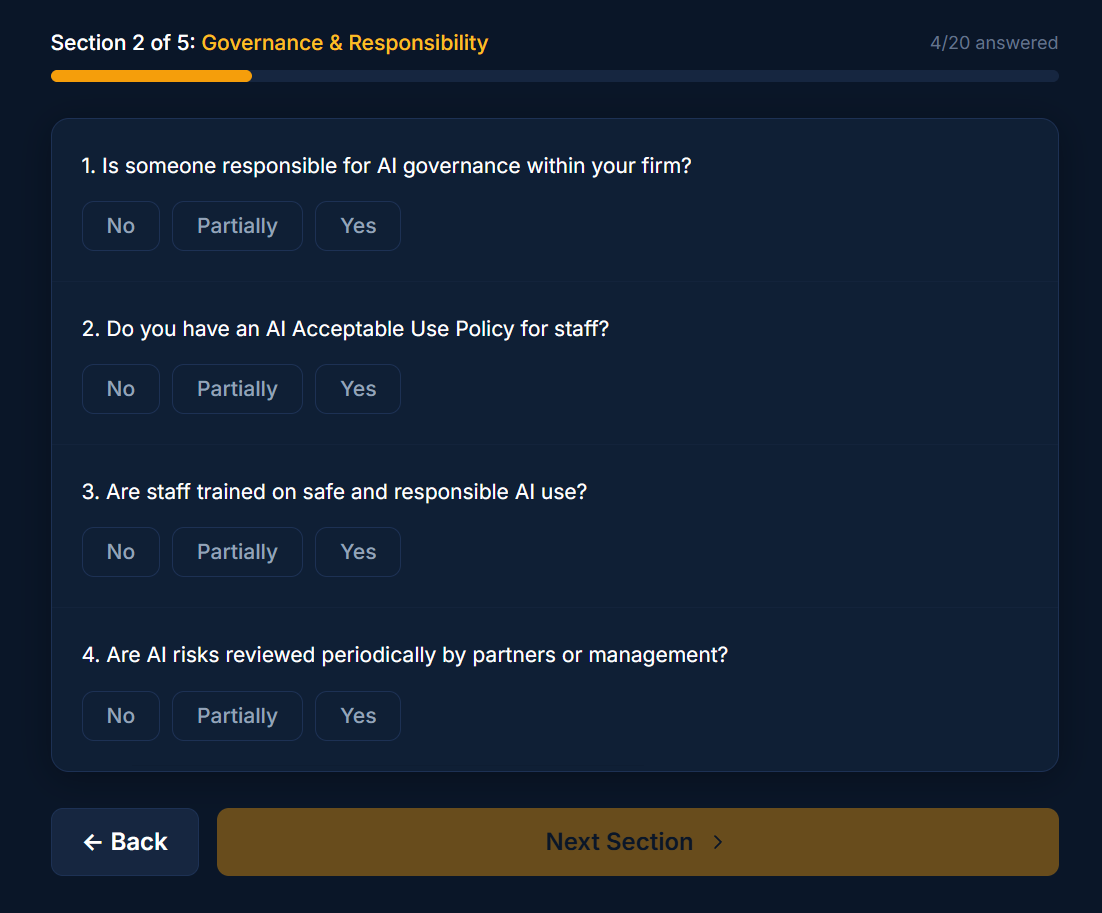
Step 3: Complete Section 2 — Governance & Responsibility
This section looks at whether the firm has assigned responsibility for AI governance and whether staff have structure, policy, and guidance to use AI safely and consistently.
You are being asked about accountability, acceptable use policy, staff training, and whether partners or management revisit AI risks over time. This is about whether governance exists in practice, not just in principle.
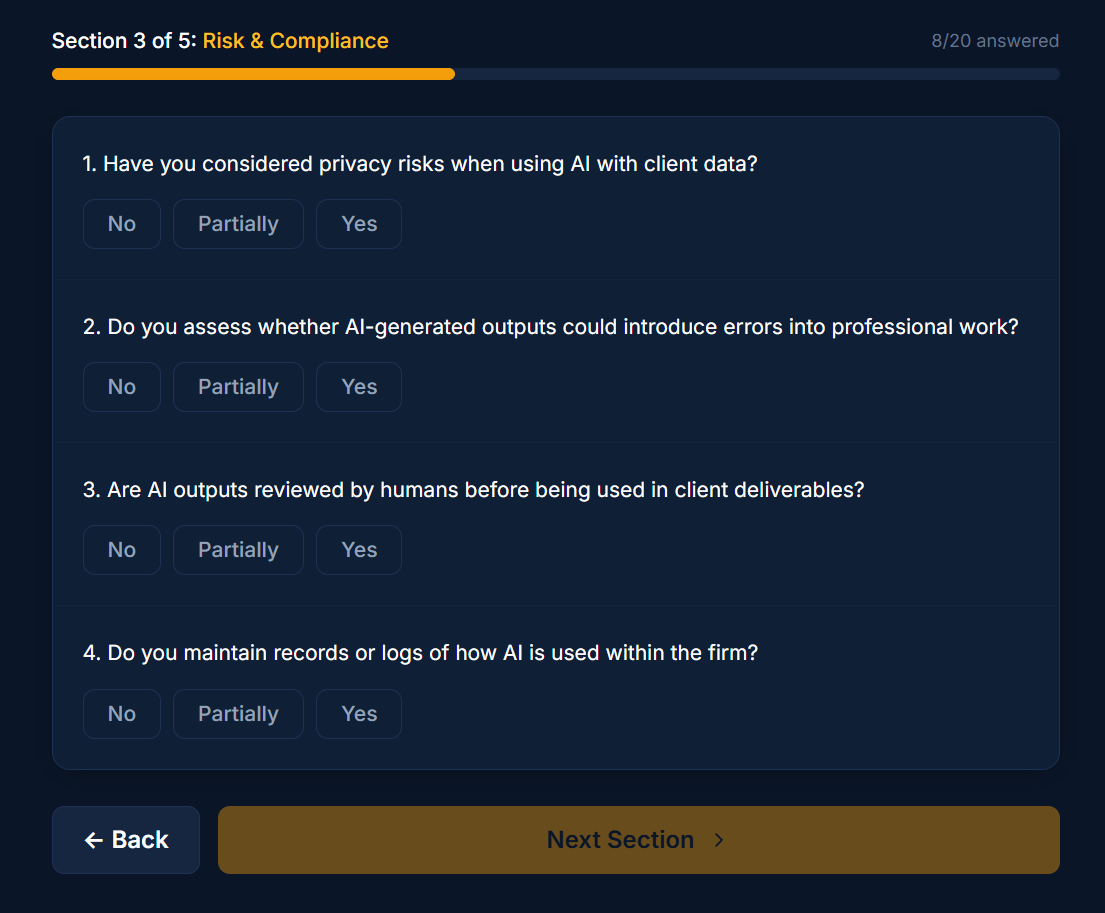
Step 4: Complete Section 3 — Risk & Compliance
This section focuses on privacy, data protection, professional risk, human review of AI outputs, and whether the firm keeps records of how AI is being used.
The key question here is whether the firm has thought carefully about confidentiality, error risk, review processes, and evidence. In an accountancy or advisory context, weak answers in this section can point to serious exposure.
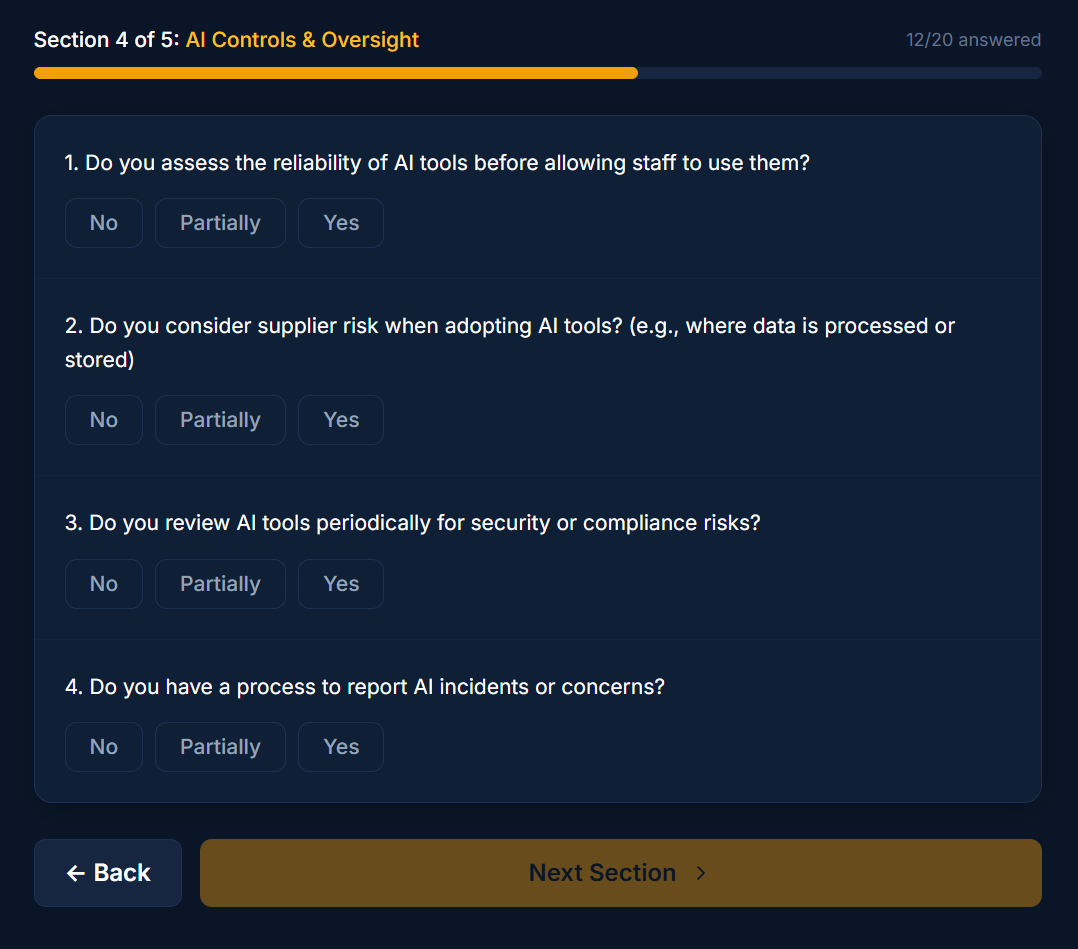
Step 5: Complete Section 4 — AI Controls & Oversight
This section looks at the firm’s control environment. It asks whether tools are checked before adoption, whether supplier risk is considered, whether tools are reviewed over time, and whether staff know how to report incidents or concerns.
In simple terms, this is the operational oversight section. It tests whether the firm is carrying out sensible checks before and during the use of AI tools.
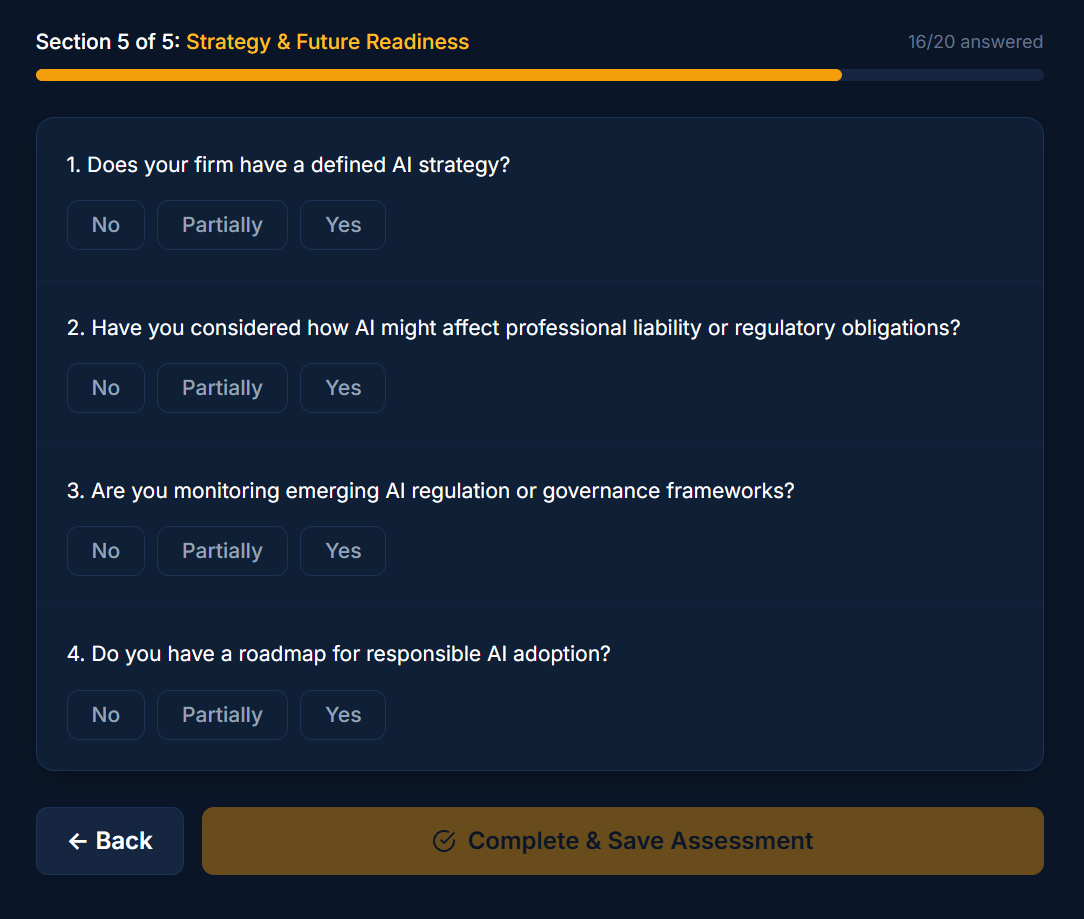
Step 6: Complete Section 5 — Strategy & Future Readiness
The final section looks forward. It asks whether the firm has a defined AI strategy, has considered liability and regulatory impact, monitors emerging AI governance frameworks, and has a roadmap for responsible adoption.
Good AI governance is not only about handling today’s risks. It is also about being deliberate and prepared as AI continues to evolve across the profession.
Step 7: Complete the Assessment and Review the Results
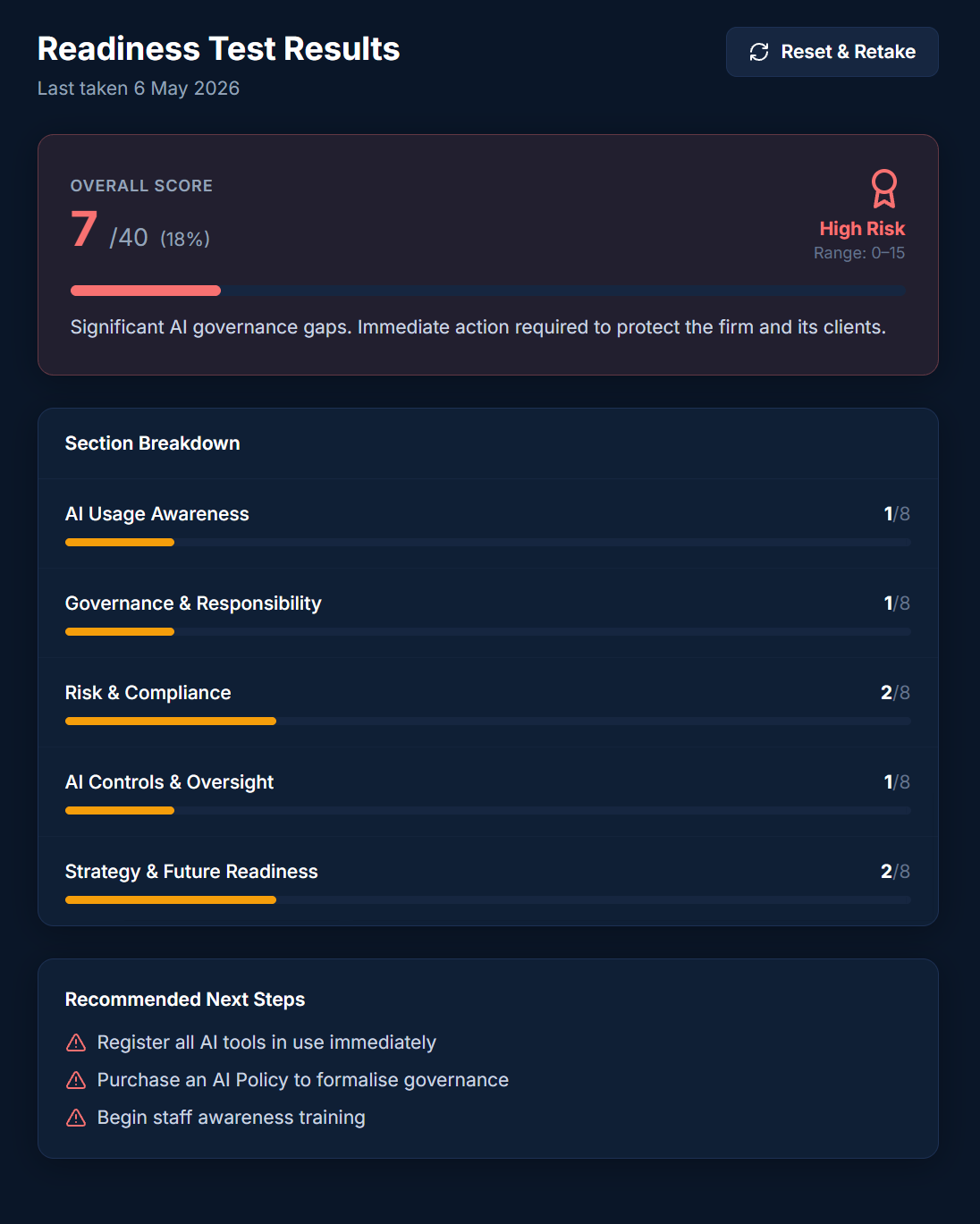
After answering the questions in the final section, select Complete & Save Assessment. You will then be shown a results screen summarising your overall score, risk label, section breakdown, and suggested next steps.

Understanding Your Results
The overall score is designed to give you a quick picture of your firm’s current readiness. A lower score means there are more gaps in governance, oversight, risk management, or strategic planning. In practical terms, it suggests greater exposure to inconsistent use of AI, weak controls, avoidable mistakes, or regulatory and client risk.
The risk label adds interpretation. A High Risk result does not mean the firm cannot use AI at all. It means the firm is still at an early stage of governance maturity and should prioritise foundational controls before assuming AI use is well managed.
Section Breakdown
The section-by-section view is often more useful than the overall score alone. It shows where the firm is relatively stronger and where the biggest weaknesses are likely to sit.
- A very low score in AI Usage Awareness may suggest poor visibility over tool usage.
- A low score in Governance & Responsibility may point to weak ownership, policy, or training.
- A low score in Risk & Compliance may suggest concerns around privacy, human review, or record keeping.
- A low score in AI Controls & Oversight may show weak pre-adoption checks or incident handling.
- A low score in Strategy & Future Readiness may suggest the firm is reacting to AI rather than planning for it.
Recommended Next Steps
The recommendations at the end of the test are there to turn the result into practical action. In the example shown, the suggested next steps include registering AI tools already in use, formalising governance through policy, and beginning staff awareness training.
Start with the fundamentals:
gain visibility over tool usage, put clear governance documentation in place, and make sure staff understand how to use AI safely and responsibly.
Using the Results Well
- Use the results to identify the biggest gaps first.
- Prioritise actions that reduce immediate risk, such as visibility over tools, clear rules on client data, and human review of outputs.
- Repeat the assessment periodically so you can track improvement over time.
- Use the section breakdown to guide policy, training, governance, and internal review priorities.
A low score is not a reason to avoid the exercise. In many firms, it is the clearest way to understand what needs attention first and where effort should be focused next.
Look Out for Common Mistakes
- Answering based on what the firm intends to implement rather than what exists today.
- Giving full credit for controls that are only informal or inconsistently followed.
- Treating the overall score as the only thing that matters and ignoring the section breakdown.
- Viewing the result as a pass-or-fail judgment instead of a practical diagnostic.
- Failing to act on the recommended next steps after the assessment is complete.
Take the AI Governance Readiness Test
If your firm is already using AI, this assessment gives you a practical way to understand current maturity, identify governance gaps, and decide what should be improved first.
Risk awareness
AI readiness